


Pacific Research Peptides
Peptide Research Library
Explore 35 research peptide guides, compound profiles, comparisons, laboratory methods, COA resources, and topic hubs for informed research purchasing.
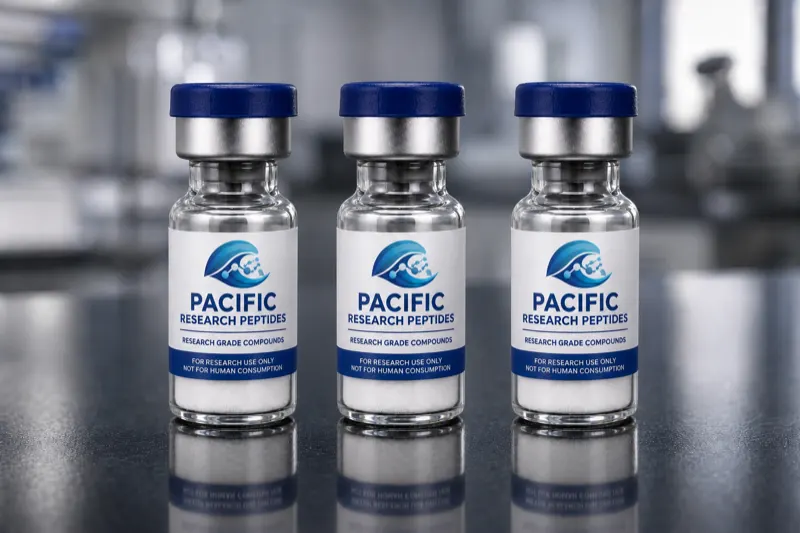
A research peptide library built for informed laboratory purchasing
Explore original compound profiles, product comparisons, documentation guides, and research-topic hubs. Each resource is organized to help qualified buyers identify the exact catalog record, compare listed formats, and verify available documentation before ordering.
- 35
- Research guides
- 6
- Topic hubs
- 1
- Searchable COA library
Follow the evidence before choosing a catalog record
Start with the public record, match its identifiers, and read each reported result only within the method and sample described. These resources form one verification path; they do not imply that a historical document applies to current inventory.
Search published COA records
Filter the public redacted library, then open and review the underlying record.
Review resource Verification workflowHow to read a COA
Use the six-point review, method-scope matrix, and printable documentation worksheet.
Review resource Analytical methodsHPLC vs mass spectrometry
Separate chromatographic results from identity evidence and other reported attributes.
Review resource Reported attributesPurity vs net peptide content
Understand why a percentage and a material-content value answer different questions.
Review resource Record matchingBatch vs lot identifiers
Connect a public document to the exact labeled research material without assuming interchangeability.
Review resource Public recordsWhy information may be redacted
See how public copies can protect sensitive details while preserving useful verification fields.
Review resource Documentation scopeWhat product records show
Review what published records establish and where their limits begin.
Review resource Catalog processHow research products are evaluated
Understand the documented catalog-review process without treating it as a medical or outcome claim.
Review resourceCompound reference profiles
Identify compounds, terminology, formats, and the corresponding research catalog pathways.
What Is BPC-157? Research Identity & COA Guide
Understand BPC-157 research identity, terminology, catalog distinctions, COA checks, and literature matching for laboratory procurement.
Read guideWhat Is Cagrilintide? Research Identity & COA Guide
Understand Cagrilintide research identity, terminology, catalog distinctions, COA checks, and literature matching for laboratory procurement.
Read guideWhat Is CJC-1295? Research Identity & COA Guide
Understand CJC-1295 terminology, DAC status, blend identity, and the COA checks needed before comparing laboratory catalog records.
Read guideWhat Is DSIP? Research Identity & COA Guide
Understand DSIP research identity, terminology, catalog distinctions, COA checks, and literature matching for laboratory procurement.
Read guideWhat Is Epithalon? Research Identity & COA Guide
Understand Epithalon research identity, terminology, catalog distinctions, COA checks, and literature matching for laboratory procurement.
Read guideWhat Is GHK-Cu? Research Identity & COA Guide
Understand GHK-Cu research identity, terminology, catalog distinctions, COA checks, and literature matching for laboratory procurement.
Read guideWhat Is Ipamorelin? Research Identity & COA Guide
Understand Ipamorelin research identity, terminology, catalog distinctions, COA checks, and literature matching for laboratory procurement.
Read guideWhat Is KLOW? Research Identity & COA Guide
Understand KLOW research identity, terminology, catalog distinctions, COA checks, and literature matching for laboratory procurement.
Read guideWhat Is KPV? Research Identity & COA Guide
Understand KPV research identity, terminology, catalog distinctions, COA checks, and literature matching for laboratory procurement.
Read guideWhat Is MOTS-C? Research Identity & COA Guide
Understand MOTS-C research identity, terminology, catalog distinctions, COA checks, and literature matching for laboratory procurement.
Read guideWhat Is NAD+? Laboratory Research & Documentation Guide
What is NAD+? Understand NAD+ versus NADH, why it is not a peptide, and how to check research material identity, batch records and COAs.
Read guideWhat Is Selank? Research Identity & COA Guide
Understand Selank research identity, terminology, catalog distinctions, COA checks, and literature matching for laboratory procurement.
Read guideWhat Is Semax? Research Identity & COA Guide
Understand Semax research identity, terminology, catalog distinctions, COA checks, and literature matching for laboratory procurement.
Read guideWhat Is SS-31? Research Identity & COA Guide
Understand SS-31 research identity, terminology, catalog distinctions, COA checks, and literature matching for laboratory procurement.
Read guideWhat Is TB-500? Research Identity & COA Guide
Understand TB-500 research identity, terminology, catalog distinctions, COA checks, and literature matching for laboratory procurement.
Read guideWhat Is Tesamorelin? Research Identity & COA Guide
What is Tesamorelin? Learn its GHRH analogue classification and how to compare research materials, labeled amounts, batch records and COAs.
Read guideResearch compound comparisons
Compare classification, catalog identity, documentation, and listed formats without dosing or outcome claims.
Batch vs Lot Numbers: How Research Materials Connect to COA Records
Learn how batch and lot numbers connect research-material labels to COA records, what to compare, and what an identifier cannot prove.
Read guideBPC-157 and TB500: Why Labs Compare Them Together
Compare BPC-157 and TB-500 research identity, catalog distinctions, literature matching, blends, and COA review requirements.
Read guideCAS Number vs Catalog Number: A Research Procurement Guide
Distinguish a CAS substance identifier from a supplier catalog number and a batch or lot reference when reviewing research-material records.
Read guideCOA vs Safety Data Sheet: Which Document Should You Request?
Learn when to request a COA or safety data sheet, how to distinguish their purposes, and which identifiers help match research documentation.
Read guideHPLC vs Mass Spectrometry: What Each Test Shows on a Peptide COA
Learn how HPLC purity and mass-spectrometry identity evidence differ when reviewing a peptide Certificate of Analysis for laboratory procurement.
Read guidePeptide Purity vs Net Peptide Content: Why the Percentages Differ
Learn why an HPLC purity percentage and net peptide content answer different analytical questions when reviewing research-material documentation.
Read guidePeptide vs Amino Acid vs Protein: A Laboratory Research Guide
Compare amino acids, peptides, polypeptides, and proteins, including peptide bonds, sequence direction, molecular form, and documentation limits.
Read guideRetatrutide vs Semaglutide: Research Catalog & COA Comparison
Compare Retatrutide and Semaglutide research identity, receptor classification, catalog records, and COA checks for laboratory procurement.
Read guideRetatrutide vs Tirzepatide in Research Models
Compare Retatrutide and Tirzepatide receptor classifications, experimental-model records, and evidence limitations for laboratory research.
Read guideRetatrutide vs Tirzepatide: Research Catalog & COA Comparison
Compare Retatrutide and Tirzepatide research identity, receptor classification, catalog records, and COA checks without personal-use guidance.
Read guideSemaglutide vs Tirzepatide Research: Comparing Assays and Material Records
Compare Semaglutide and Tirzepatide research records: receptor assays, material identity, analytical evidence and questions to resolve before procurement.
Read guideSemax vs Selank: Two Different Nootropic Research Tools
Compare Semax and Selank research identity, nomenclature, literature records, catalog paths, and documentation checks.
Read guideLaboratory methods and buying guides
Learn how to review COAs, documentation, vial formats, supplier records, and laboratory workflow details.
Choosing the Right Vial Size for Peptide Research
Compare labeled vial strength, documentation, project requirements, and inventory controls before selecting research-material quantities.
Read guideHow Labs Build a Metabolic Peptide Workflow
Plan a documentation-first metabolic research workflow using exact compound identity, literature matching, controls, COAs, and recordkeeping.
Read guideHow to Evaluate a Research Peptide Supplier
Evaluate a research peptide supplier using batch documentation, COA scope, catalog identity, support policies, and research-use boundaries.
Read guideHow to Read a Peptide COA Before You Buy
Use a practical checklist to match a peptide product and batch to its COA, methods, identity evidence, purity result, and report date.
Read guideLaboratory Concentration Math: Reconstitution Records & Unit Checks
Learn how laboratories document sample mass, final volume, concentration math, aliquot units, and traceability without personal-use guidance.
Read guideTesamorelin, Ipamorelin, and CJC-1295: A GH-Axis Research Primer
Understand key identity and receptor-classification differences among Tesamorelin, Ipamorelin, and CJC-1295 research records.
Read guideWhy Third-Party Testing Matters in Peptide Sourcing
Learn how to evaluate third-party laboratory identity, methods, sample identifiers, dates, results, and COA limitations before ordering.
Read guideResearch topic hubs
Follow a focused path from neutral terminology and comparisons into the matching catalog category and available documentation.
How to read a COA
Understand identifiers, methods, dates, results, and document integrity.
Planning toolsResearch calculators
Use neutral arithmetic for concentration, volume, and inventory planning.
Research topic hubGLP-1 research
Review catalog context, comparisons, documentation, and neutral terminology.
Research topic hubGrowth hormone research
Explore the catalog and educational resources organized around this research area.
Research topic hubHealing and repair research
Explore the catalog and educational resources organized around this research area.
Research topic hubLongevity research
Explore the catalog and educational resources organized around this research area.
Research topic hubNootropic research
Explore the catalog and educational resources organized around this research area.
Research topic hubCosmetic research
Explore the catalog and educational resources organized around this research area.
Independent educationResearch Peptide Institute
Continue to terminology and documentation-focused educational resources.
Looking for research peptides online?
Use the Pacific Research Peptides catalog to compare currently listed compounds, strengths, vial formats, stock status, pricing, and available documentation. Match the exact product and batch record rather than assuming that one document applies to every strength or lot.
Using this library
What information should a research peptide supplier make easy to verify?
At minimum, confirm the compound identity, listed strength, vial format, current price, stock status, research-use-only boundary, and any available batch or laboratory documentation.
How should I compare research peptides from different suppliers?
Compare like-for-like catalog records. Check the exact compound, strength, format, documentation scope, lot identifiers, fulfillment terms, and support route instead of comparing product names alone.
What should match between a peptide product and its COA?
Match the compound, strength, batch or lot, test date, laboratory, and reported analytical method. A report for another strength or lot should not be treated as interchangeable.
Does this library provide dosing or personal-use information?
No. Pacific Research Peptides publishes laboratory research and procurement information only. It does not provide medical, dosing, administration, protocol, safety, efficacy, or personal-use guidance.