


Research documentation · Document selection
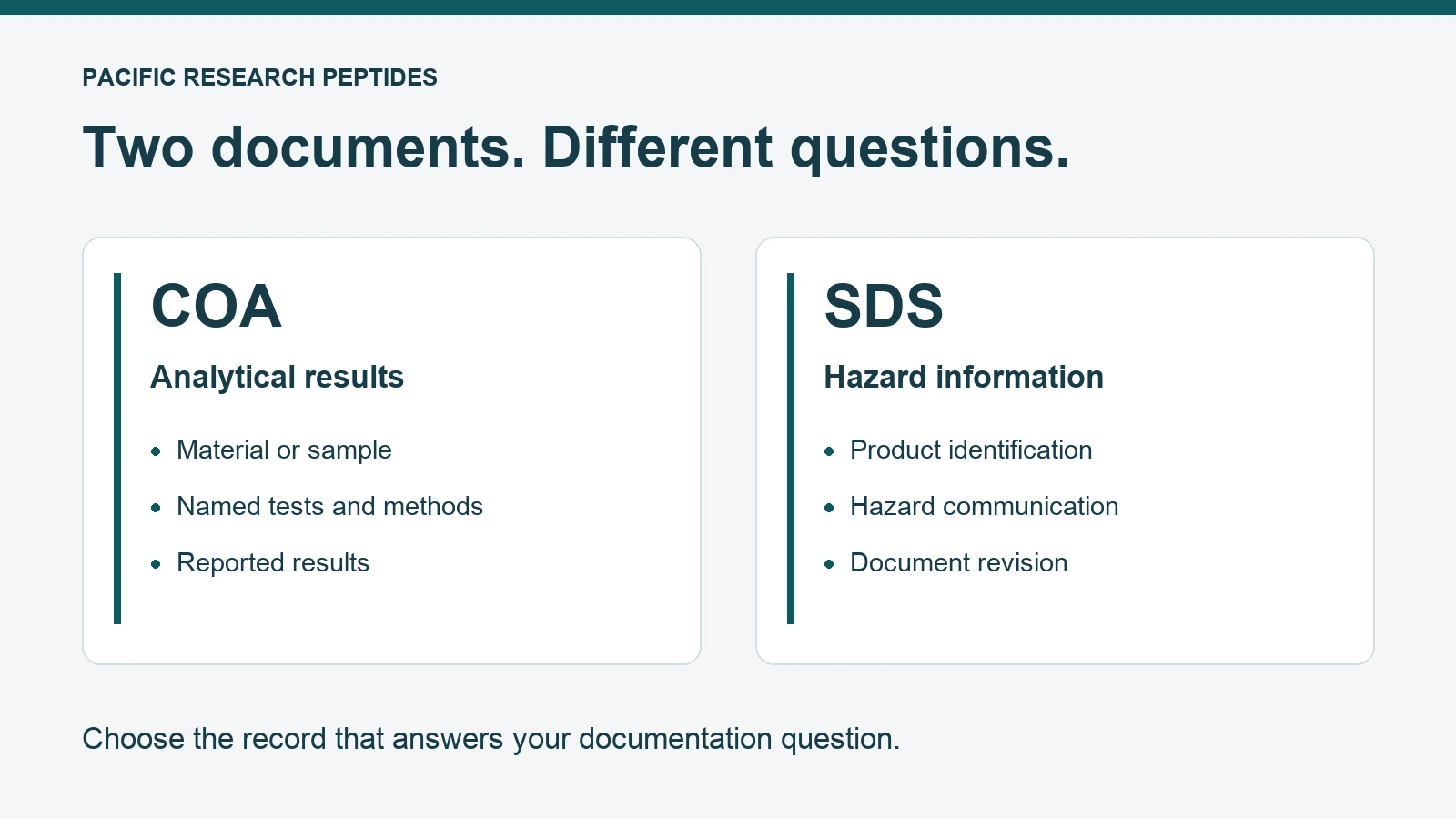
A certificate of analysis (COA) and a safety data sheet (SDS) answer different questions. A COA records analytical information for the material or sample it identifies. An SDS communicates hazard information for the chemical product it describes. Requesting one when you need the other can leave a laboratory procurement review incomplete.
For a research buyer, the useful starting point is the question: are you trying to locate a reported test result, or the supplier’s hazard information? Match the document to that question, then check which material it actually describes.
Research-use-only scope. Pacific Research Peptides products are supplied strictly for laboratory research use only and are not for human or animal consumption. This guide explains document selection, not laboratory handling procedures or personal-use advice.
COA versus SDS: which document answers your question?
| Question | Start with | What to check |
|---|---|---|
| What analytical result is reported for this identified sample or lot? | COA or analytical report | Sample identity, method, units and the actual reported result. |
| Where is the supplier’s hazard information for this chemical product? | SDS | Product identification and the applicable document revision. |
| Does the report correspond to the material being offered? | COA together with the label and catalog record | The complete material designation and identifiers, not a similar filename. |
| Which document should our institution retain for its review? | The document requested by the responsible institutional reviewer | Record the document type explicitly; “product paperwork” is too vague. |
The last question is an institutional decision. A general article cannot determine which documents satisfy a particular laboratory’s purchasing or environmental health and safety review.
What a certificate of analysis contributes
Read a COA as a bounded record. Identify the named material, the sample or batch reference, the issuer, the tests and the results that are actually present. A number on a certificate needs its method and units; a listed specification should not be mistaken for a measured result.
As one established documentation example, ICH Q7 section 11.4 describes certificates with a material name, batch identifier, release date, tests, acceptance limits, numerical results where applicable and authorization information. FDA’s Q7A guidance provides the source text. That guidance concerns pharmaceutical active-ingredient quality systems; citing it does not establish that PRP or a research material is approved, certified or governed by Q7.
For the full reading sequence, use How to Read a Peptide COA Before You Buy. Keep method-level questions with the HPLC and mass-spectrometry guide.
What a safety data sheet contributes
OSHA’s SDS format organizes hazard communication into numbered sections. Section 1 identifies the product and responsible party; section 2 presents hazard identification; section 3 addresses composition and ingredients; section 16 includes the preparation or revision date. The current OSHA SDS section reference describes the contents.
Use those fields to locate the appropriate sheet and identify its version. A chemical identifier or composition entry on an SDS is not a substitute for a sample-specific analytical result. Likewise, a COA result does not replace the hazard information in an SDS.
This comparison does not decide whether a specific SDS requirement applies to a supplier, product or institution. Questions about workplace requirements and handling decisions belong with the responsible institutional specialist and the applicable product documentation.
Match documents without forcing their dates to agree
A COA date and an SDS revision date describe different records. Do not infer that a certificate belongs to the wrong material merely because its date differs from the SDS. Conversely, matching dates do not demonstrate that two documents describe the same product.
Compare the material designation and any product code or form stated on each document. For the COA, also check the sample or lot correspondence. The batch and lot number guide explains that connection. If a qualifier is missing or the identifiers conflict, record the unresolved field and request clarification; do not silently substitute another product’s sheet.
A clear document request for laboratory procurement
A useful request names both the document and the unresolved question. Include:
- The exact catalog name and product page URL.
- The displayed form or labeled amount, where relevant to identifying the listing.
- The batch or lot identifier, if available and relevant to the requested report.
- The document type: COA, underlying analytical report or SDS.
- The filename, report number or revision being queried, if one is already in hand.
- The specific missing information, such as document correspondence or which revision is current.
For example: “For the catalog item at product URL, please identify the available COA corresponding to lot identifier. Separately, please confirm whether an SDS is available for that exact product and identify its revision.” This is an illustrative request template, not a statement that a particular PRP document exists.
Start with the live PRP COA and lab-report library for published analytical records. Use documentation support for a document-location or correspondence question. A missing public download remains an open availability question; do not label it as completed testing or infer that a different document can stand in for it.
Keep the conclusion within the record
The strongest outcome of this review is a clear record of what you have, what it describes and what is still missing. Neither a COA nor an SDS establishes suitability for human or animal use. Neither should be stretched into evidence for an unreported characteristic.
For the wider relationship among catalog entries, labels and reports, continue with Research Peptide Product Documentation.
Prepared by Pacific Research Peptides. This guide was developed by comparing the cited primary document descriptions with PRP’s published documentation resources. It is a document-literacy synthesis, not independent testing, expert certification or a legal applicability determination.
Published: September 21, 2026
Sources reviewed: September 21, 2026