


Research comparisons · Laboratory records
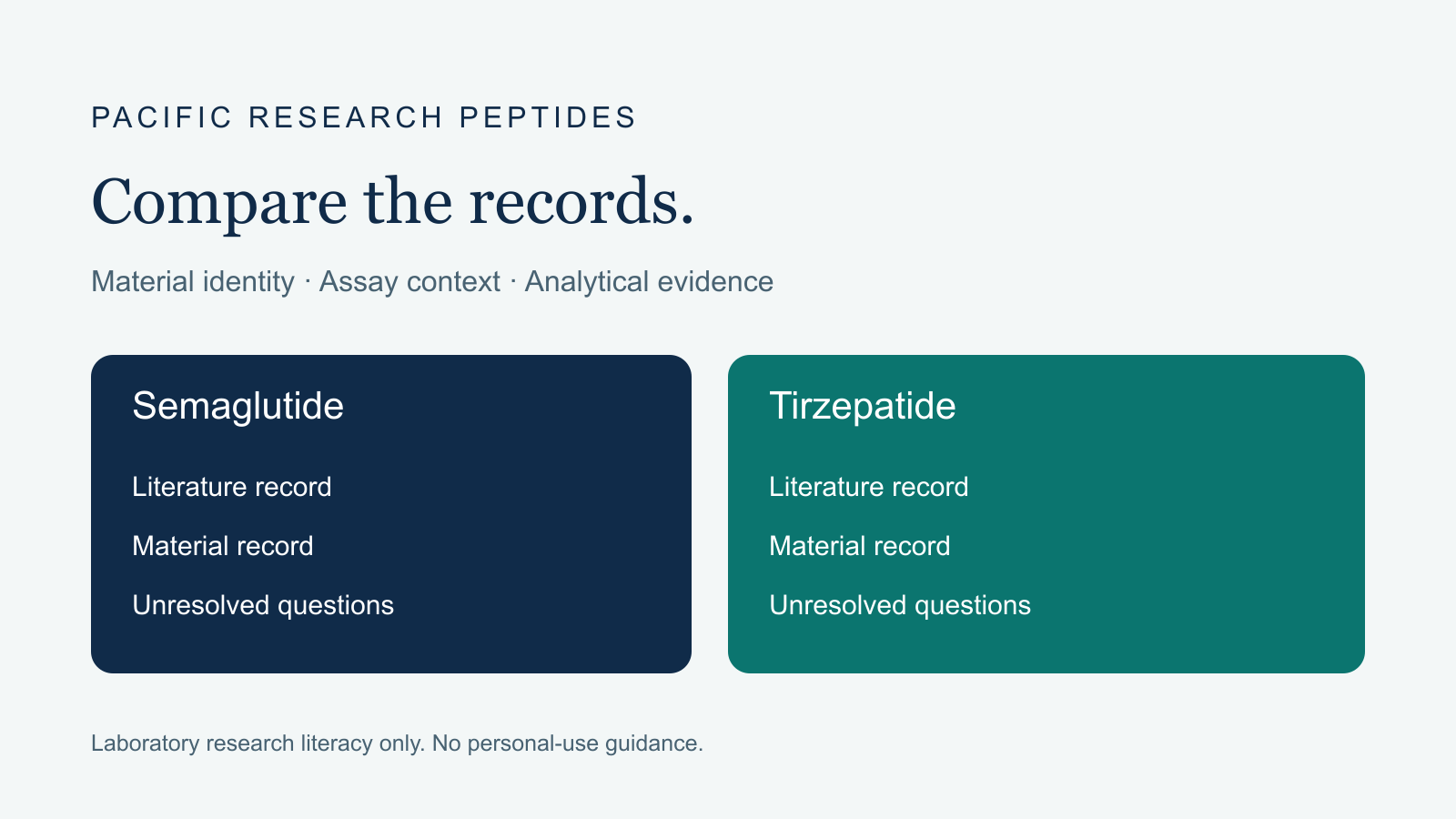
Semaglutide and Tirzepatide are different research materials. A useful laboratory comparison records the receptor, assay conditions and measured endpoint alongside the identity of each material. A shared category label is not enough to make two results comparable.
Semaglutide is classified as a GLP-1 receptor agonist; Tirzepatide is a dual GIP and GLP-1 receptor agonist. Those classifications describe receptor pharmacology, not a ranking of experimental suitability. Willard and colleagues’ receptor study provides an example of why the underlying methods matter.
Research-use-only scope. This article supports literature and procurement-record review for qualified laboratory research. It provides no dosing, preparation, administration, treatment or personal-use guidance. PRP products are not for human or animal consumption.
Compare the same question before comparing the result
A comparison sheet should state a specific question: for example, whether two publications measured the same signaling endpoint at the same receptor. If one record concerns GLP-1R and another concerns GIPR, place that difference beside the result rather than hiding it in a footnote.
In the Willard study, the authors examined receptor expression and albumin conditions when interpreting activity. They reported an albumin-associated shift for Semaglutide as well as Tirzepatide. This is a reason to retain assay context when reading a potency value; it is not a formula for converting one compound into the other. The paper’s findings apply to its materials and experimental systems, not automatically to a commercial vial.
A comparison worksheet for two material records
Create separate columns for Semaglutide and Tirzepatide. The following fields help distinguish an actual match from an unanswered question.
| Field | What to record for each compound | What the field answers |
|---|---|---|
| Publication | Paper, figure or table, and methods section | Where does the result come from? |
| Experimental context | Receptor, model, endpoint and relevant assay conditions | Are the reported measurements comparable? |
| Material identity | Exact name, supplier and catalog identifier | Which material does the record describe? |
| Supplied item | Selected labeled strength and format | Which catalog item is under review? |
| Analytical evidence | Report identifier, sample or lot, method and date | Which tested sample supports the reported finding? |
| Unresolved fields | Missing information and the question to send to its source | What still needs verification? |
This is an organizational worksheet, not a validated experimental protocol. For general terminology, RPI’s introductory receptor comparison provides a separate starting point. RPI is affiliated with PRP.
Keep literature evidence separate from supplier evidence
A research paper and a supplier report answer different questions. The paper describes the authors’ study. A supplier’s analytical record describes its identified sample and reported tests. Copying a paper citation into a procurement file does not establish that an available item is the same material used by the authors.
For example, imagine a comparison file with a Semaglutide publication in one column and a Tirzepatide supplier report in the other. Both documents may be relevant, but they are not equivalent evidence. Add a separate literature row and a separate analytical-record row for each compound. Mark missing entries as unknown; do not fill them with a report for the other compound.
Our existing COA reading guide covers report interpretation. Use it for that task rather than treating this comparison as a substitute for a full documentation review.
Follow the exact catalog and documentation paths
Use the Semaglutide product record and Tirzepatide product record to identify the current listed items. Check the selected strength and the documentation status shown there; this article does not promise availability or current-lot testing.
The Semaglutide 10 mg documentation record is a specific navigation destination, not a guarantee that a historical report matches supplied stock. Resolve that match before treating a report as evidence for a particular lot.
What should a completed comparison establish?
It should make clear which questions the records answer and which remain open. It should not conclude that the compounds are interchangeable, that a receptor label predicts a personal outcome, or that a literature citation certifies a supplier’s material. A useful record preserves those boundaries while making the next verification step straightforward.
Sources and editorial method
Prepared by Pacific Research Peptides from Willard et al., JCI Insight (2020), doi:10.1172/jci.insight.140532. The worksheet and mismatched-document example are editorial tools, not a validated protocol or independent certification. No independent expert review is claimed. For documentation questions or corrections, contact PRP.
Published: October 14, 2026
Sources reviewed: October 14, 2026