


Analytical documentation · Peptide content
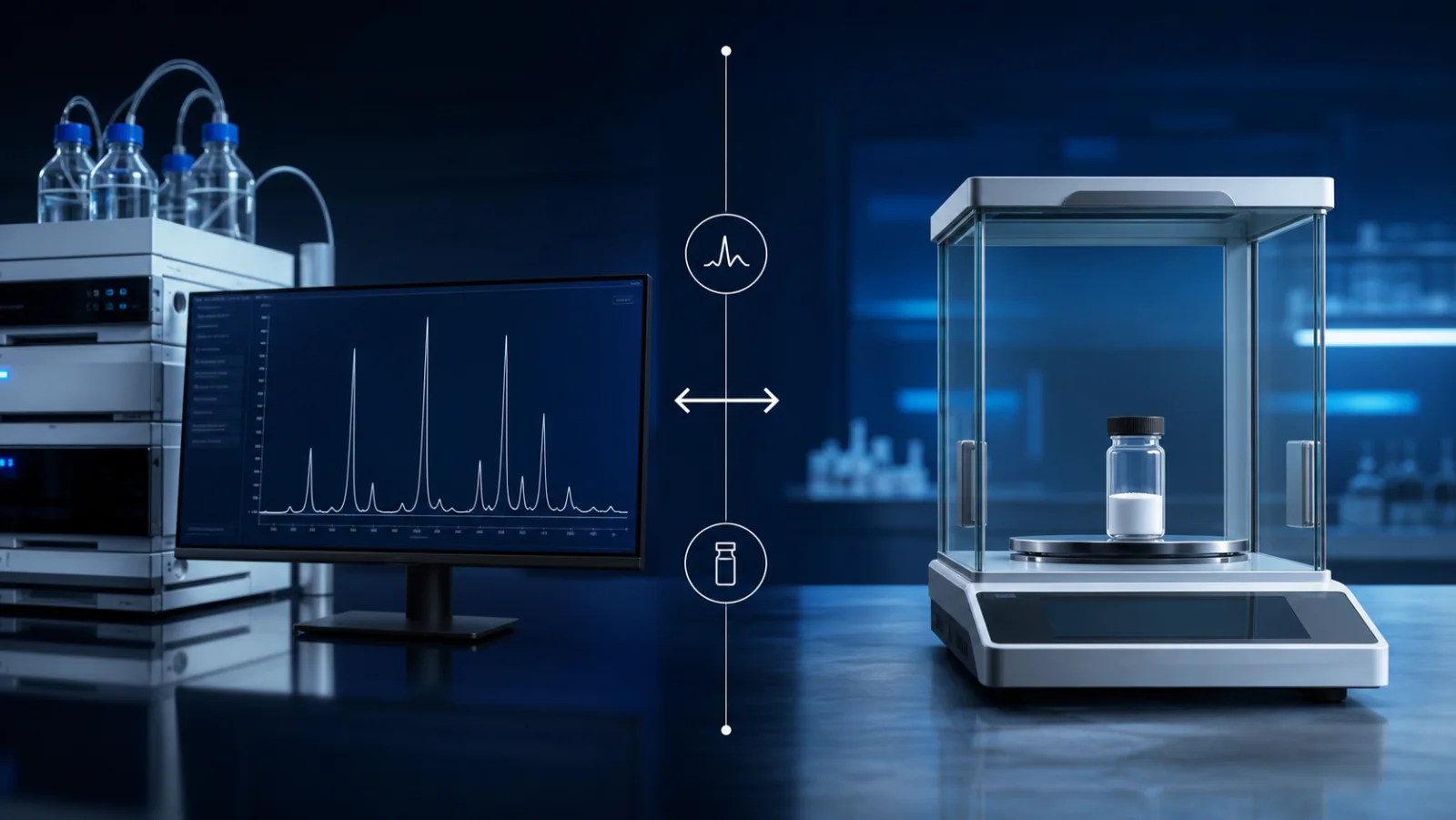
Short answer: peptide purity and net peptide content are not interchangeable percentages. A chromatographic purity result describes the relative detector response assigned to the main peptide peak under a stated method. Net peptide content is a mass-based content value intended to describe how much of a material is attributable to the peptide itself. A high HPLC purity result therefore does not, by itself, establish peptide mass per vial or net peptide content.
This distinction matters when a laboratory reviews a Certificate of Analysis, specification, or supplier document. Two percentages can both be analytically valid while answering different questions. The useful review task is not to choose the larger number; it is to identify the measurand, method, units, sample, and lot behind each result.
What does a peptide purity percentage measure?
On many peptide records, “purity” refers to a chromatographic result, often reversed-phase HPLC with ultraviolet detection. The instrument separates detectable sample components under defined conditions. Software then integrates selected peaks, and the report may express the main peak as a percentage of the total integrated peak area included in the calculation.
That percentage is method-dependent. Sample preparation, column chemistry, mobile phase, gradient, wavelength, integration settings, and the detector responses of different components can all affect the result. An area percentage is evidence about the chromatographic profile produced by that procedure. It is not automatically a direct mass fraction of every substance present in the weighed material.
The FDA’s Q2(R2) guidance treats identity, assay, purity, and impurity procedures as different analytical purposes and emphasizes that a procedure must be fit for its intended purpose. That general principle is useful here: a purity method should not be assumed to answer a separate quantity or content question unless the procedure and calculation actually support it.
What does net peptide content mean?
“Net peptide content” is commonly used for a mass-based estimate or assigned value for the peptide portion of a material after non-peptide contributions are considered. Depending on the laboratory and specification, those contributions can include water, counterions, salts, residual processing components, or other measured impurities. The exact definition is not universal, so a document should state the method, basis, and units rather than relying on the acronym or label alone.
Peptide metrology work illustrates why content assignment can require more than one number. NIST-linked research on an angiotensin I reference material evaluated mass balance, peptide-impurity-corrected amino acid analysis, elemental analysis, and quantitative nuclear magnetic resonance for peptide purity mass-fraction assignment. A multi-laboratory study led by USP researchers likewise compared HPLC assay, quantitative NMR, and amino acid analysis for assigning oxytocin content.
These studies concern carefully characterized reference materials, not PRP products. They support the broader analytical point that peptide quantity or mass-fraction assignment depends on a defined measurement approach and appropriate reference standards.
Peptide purity versus net peptide content at a glance
| Review question | Chromatographic purity | Net peptide content |
|---|---|---|
| What is being described? | The relative chromatographic response assigned to the principal peptide peak within the stated integration. | A mass-based value intended to describe the peptide portion of the material under a defined calculation. |
| Typical analytical basis | Often RP-HPLC with UV detection and peak-area integration. | May use a validated assay, amino acid analysis, qNMR, mass balance, or another justified quantitative approach. |
| What can affect it? | Separation, wavelength, response factors, integration rules, co-elution, and method selectivity. | Water, counterions, salts, non-peptide components, impurity corrections, standards, and measurement uncertainty. |
| What does it not prove alone? | Total peptide mass, labeled vial amount, identity, sterility, endotoxin status, or every impurity class. | Chromatographic homogeneity, molecular identity, sterility, endotoxin status, or batch-to-vial matching. |
| Best review practice | Read the method, chromatogram, integration, result, and sample identifiers together. | Read the definition, quantitative method, units, basis, uncertainty or acceptance criteria, and sample identifiers together. |
Why can the two percentages differ?
Chromatographic area is not automatically total sample mass
An HPLC-UV detector responds to compounds that reach the detector and absorb at the selected wavelength. Components can differ in response, and some non-peptide material may not be represented proportionally in the integrated chromatogram. A main-peak area percentage therefore should not be read as a gravimetric inventory of everything in the sample.
Lyophilized material can contain non-peptide mass
Synthetic peptides can be supplied with counterions, and solid peptide reference materials can also contain water and peptide impurities. Peer-reviewed work on peptide counterions recommends treating identity, purity, peptide concentration or mass fraction, residual solvents such as water, and counterions as separate quality-control characteristics. The presence or measurement of any one of these should not be invented for a specific product; it must come from the applicable record.
Quantitative methods require standards and a defined basis
An assay result is only as interpretable as its procedure, calibration, reference material, calculation, and units. The USP-led oxytocin study found method-dependent inter-laboratory performance among HPLC assay, qNMR, and amino acid analysis. That does not make one method universally correct for every peptide. It shows why the method and its intended analytical purpose belong beside the reported number.
A hypothetical example
Suppose a record reports 98% HPLC area purity and 79% net peptide content. Those values do not necessarily conflict. The first could mean that the principal peak accounted for 98% of the integrated chromatographic response under that method. The second could be a separate mass-based assignment after the laboratory applied its stated quantitative method and corrections.
The example does not establish that 79% of any PRP vial is peptide, and it should not be used to calculate a labeled amount. It simply demonstrates why two differently defined percentages cannot be substituted for one another.
How to review purity and content claims on a COA
- Match the record first: verify the compound, strength or format, batch or lot, filename, report date, and laboratory.
- Name the measurand: determine whether the result is chromatographic area purity, assay, peptide content, water, counterion content, or another attribute.
- Find the method: look for the technique, procedure reference, detector, calculation basis, and units.
- Separate identity, purity, and quantity: do not use a mass spectrum, purity percentage, or content result as a substitute for the other two questions.
- Check the sample basis: determine whether the result applies to bulk material, a finished vial, a composite, or another sampled unit.
- Look for uncertainty and limits: review acceptance criteria, reporting limits, uncertainty, qualifiers, and any stated exclusions.
- Do not infer missing tests: sterility, endotoxin, residual solvents, water, counterions, elemental impurities, and content require their own suitable evidence when relevant.
- Resolve mismatches before relying on the record: ask for clarification when the product, lot, method, or units do not align.
How this applies to Pacific Research Peptides documentation
Use the Pacific Research Peptides COA library to locate published redacted records and match each file to the applicable product and available batch information. The COA verification guide provides a broader document-review checklist, while the Peptide Research Library explains related analytical terminology. Browse the Single Vials catalog only after confirming that the product page, strength, stock state, and documentation correspond to the current procurement need.
PRP-specific product and batch statements should come only from the live catalog and its linked records. General analytical references explain how methods work; they do not verify a PRP lot, purity percentage, peptide content value, vial amount, or availability.
Primary and authoritative references
U.S. Food and Drug AdministrationQ2(R2) Validation of Analytical Procedures, final guidance, March 2024.
U.S. Food and Drug AdministrationQ6A Specifications: Test Procedures and Acceptance Criteria for Chemical Substances.
Josephs et al.SI-traceable value assignment of peptide purity using angiotensin I.
Li et al.Survey of peptide quantification methods and inter-laboratory reproducibility using oxytocin.
Stanisławska et al.The role of counterions in peptides: identity, purity, mass fraction, water, and counterion analysis.
Prepared by: Pacific Research Peptides Research Team
Reviewed by: Pacific Research Peptides Research Team
Published: August 26, 2026
Last reviewed: August 26, 2026