


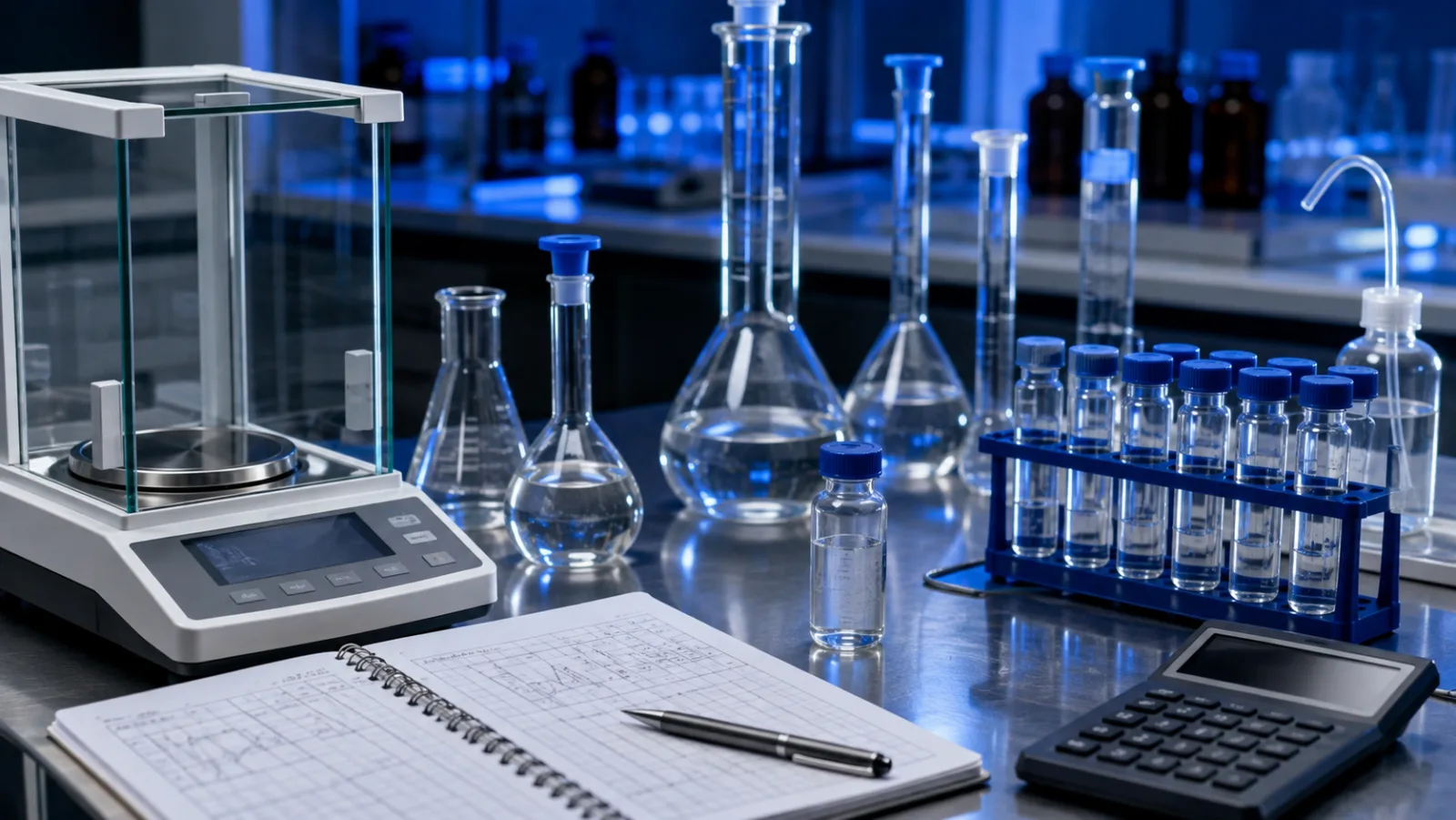
Laboratory arithmetic · Documentation controls
Short answer: Reconstitution planning for legitimate laboratory work is a concentration and record-control problem. The defensible calculation is sample mass divided by final liquid volume. A calculator can check units and arithmetic, but it cannot choose an experimental concentration, preparation procedure, solvent, handling condition, or protocol for a laboratory.
The three records that must agree
- Source record: the exact compound, form, labeled mass, batch or lot, and available analytical documentation.
- Approved method: the laboratory procedure that defines solvent, final volume, equipment, handling, controls, and acceptance criteria.
- Calculation record: the units, arithmetic, significant figures, result, operator, date, and independent check.
If any of these records is missing or inconsistent, arithmetic alone cannot make the workflow valid.
Core concentration relationship
For unit conversion, concentration in milligrams per milliliter equals the entered sample mass in milligrams divided by the entered final liquid volume in milliliters. An aliquot mass can then be calculated from that concentration and a laboratory-measured aliquot volume. The final liquid volume—not an assumed amount added—must correspond to the method’s definition.
| Field | Documentation question |
|---|---|
| Sample mass | What mass and unit are stated on the exact material record? |
| Final volume | What final liquid volume is defined by the approved method? |
| Concentration | Are the mass and volume units compatible, and is the result reported with suitable significant figures? |
| Aliquot | What calibrated laboratory device and volume unit are specified by the method? |
| Traceability | Can another reviewer reproduce the arithmetic from the recorded inputs? |
Common calculation and documentation errors
- Confusing the labeled vial amount with independently measured content.
- Mixing milligrams, micrograms, milliliters, and microliters without explicit conversion.
- Using volume added as a substitute for final volume when the method distinguishes them.
- Rounding intermediate values too early.
- Using a product image, old label, or another batch as the input source.
- Allowing a calculator result to substitute for an approved laboratory procedure.
Use the PRP calculator as an arithmetic workspace
The PRP laboratory concentration calculator performs transparent unit conversions from values entered by the user. It is intentionally separate from ordering and experimental decisions. Before relying on a result, match the selected catalog item to its available COA or laboratory record and retain the calculation inputs with the project file.
Frequently asked questions
Does the calculator recommend a concentration or solvent?
No. Those choices belong to an approved laboratory method and qualified oversight.
Does the labeled vial amount prove measured content?
No. A label is a catalog record. Review the available analytical documentation and understand which endpoints were actually tested.
Can this article be used as a personal-use guide?
No. PRP products and tools are strictly for legitimate laboratory research and analytical use, not for human or animal consumption.
Prepared by: Pacific Research Peptides Research Team
Published and reviewed: August 24, 2026