


Research procurement · Material identifiers
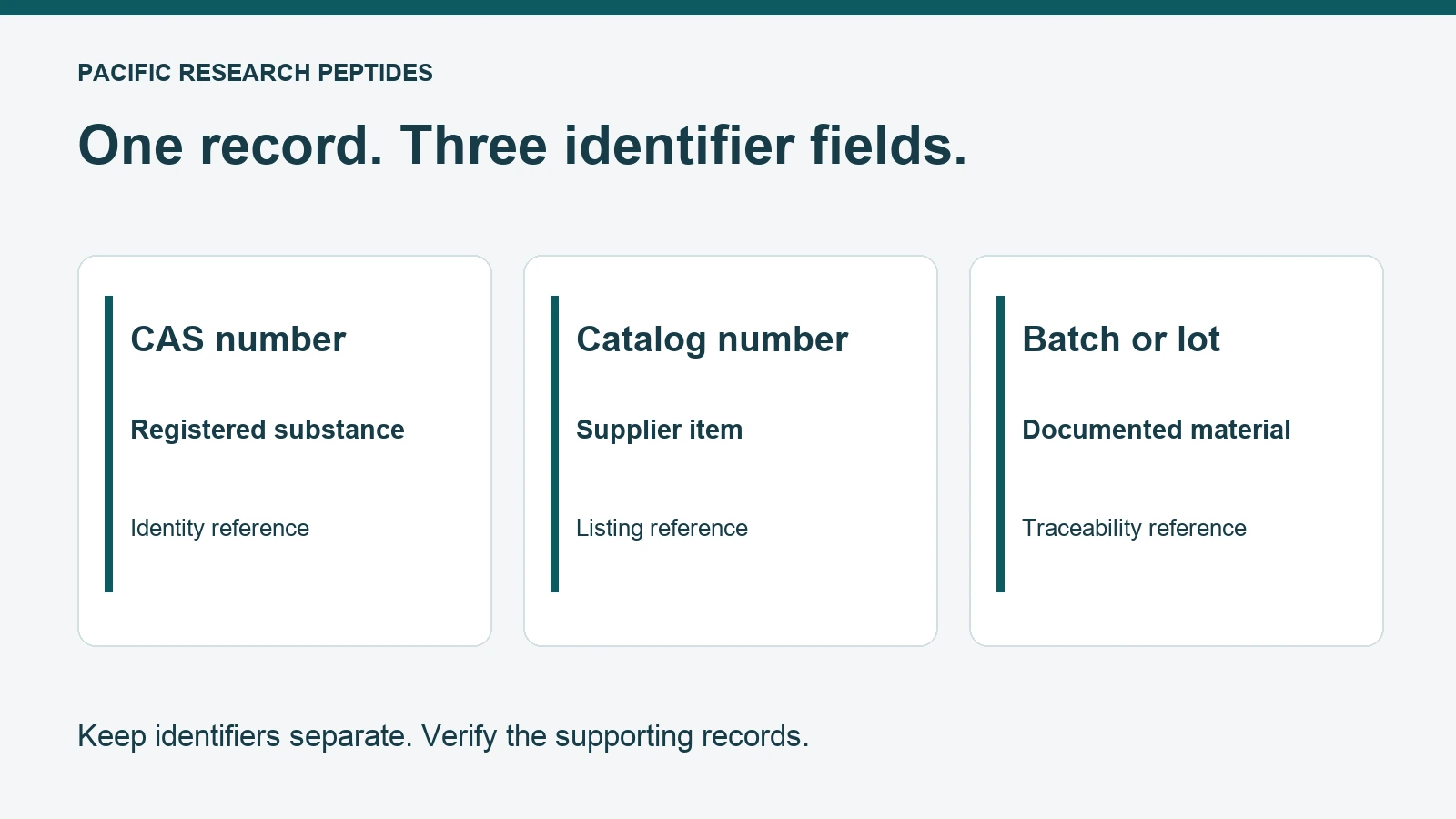
A CAS number identifies a registered chemical substance; a catalog number identifies an item in a supplier’s catalog. Record them in separate fields. Neither number is a test result, and neither replaces the batch or lot identifier needed to connect material with its analytical documentation.
For laboratory procurement, the useful question is not simply whether two numbers match. It is whether you are comparing the same kind of identifier, issued within the same system.
Research-use-only scope. Pacific Research Peptides products are supplied strictly for laboratory research use only and are not for human or animal consumption. This guide concerns documentation fields, not material preparation, administration or personal use.
What a CAS number identifies
CAS assigns a CAS Registry Number to a substance recorded in its registry. The identifier helps distinguish a substance when different names are used for it. CAS explains that the digits themselves have no inherent chemical meaning: read the associated substance record rather than trying to infer molecular properties from the number.
A registry identifier on a listing is an identity reference. Its presence does not establish that the contents of a particular vial were tested or that a report applies to the item under review. Those are separate evidence questions.
What a catalog number identifies
A catalog or order number belongs to the supplier’s item record. CAS’s own supplier-data documentation lists the catalog/order number separately from the CAS Registry Number, chemical name and structure. It also treats grade, quantities, purity and supporting documents as separate information.
Keep the supplier name and exact listing alongside its item code. Do not transfer the meaning of a catalog number from one supplier to another. When a listing offers selectable variations, retain the selected variation as well; do not assume a general listing code captures every choice.
Keep three identifier fields separate
| Field | Question it helps answer | What to retain with it |
|---|---|---|
| CAS Registry Number | Which registered substance is referenced? | The substance name and source record used for the comparison. |
| Supplier catalog or order number | Which supplier item is being considered? | Supplier, exact listing and selected variation, where applicable. |
| Batch or lot identifier | Which documented material grouping is represented? | The label and applicable report, with the issuer’s identifier intact. |
The batch and lot guide explains the third field in detail. A CAS match should not be substituted for that connection.
How to resolve an identifier mismatch
Start by naming the fields in conflict. Two different supplier catalog codes do not, by themselves, establish two different substances. Conversely, a shared CAS number does not establish that two catalog items have the same quantity, grade, analytical documentation or batch.
If a name and registry reference appear inconsistent, retain both exactly as displayed and ask the supplier to clarify the material designation and the source for the identifier. Do not silently replace the value using a search snippet or a similar-looking name. If a field is absent, mark it unavailable rather than filling it with an assumption.
A useful clarification request is: For this exact listing and selected variation, please clarify the substance designation and any CAS reference provided. Please identify which catalog code and batch or lot the available analytical record represents. This is a request for evidence, not a claim that every field or document is available.
A procurement record that preserves the distinction
Keep the exact listing URL, supplier item code, selected variation, stated substance name, registry reference and source, batch or lot, and report reference as separate entries. Record the date you checked the listing. Leave unresolved fields visible so a later reviewer can distinguish a verified match from a pending clarification.
For PRP, start with the current COA and laboratory-report library and the product documentation guide. This article assigns no CAS numbers to PRP products and makes no claim about current stock or testing availability.
Sources and editorial method
This guide compares CAS’s definitions and supplier-data fields with PRP’s existing documentation guidance. The procurement record and clarification wording are editorial examples, not a test report or a certification.
- CAS Registry Innovators Program FAQ: registry-number definition.
- CAS Chemical Supplier Insights: supplier-record fields.
- CAS supplier-data submission: catalog identifiers and substance information.
Sources accessed September 25, 2026. Prepared from the cited sources by Pacific Research Peptides; no independent expert review is claimed. For a documentation question or correction, use PRP support.
Published: September 25, 2026
Sources reviewed: September 25, 2026