


Analytical methods · Certificate of Analysis
Short answer: HPLC and mass spectrometry answer different questions. A chromatographic HPLC result describes how sample components separate under a stated method and can support a reported purity or impurity profile. Mass spectrometry measures mass-to-charge signals that can support molecular-identity assessment. Neither result, by itself, establishes every property of a research material.
When a peptide Certificate of Analysis lists both an HPLC chromatogram and a mass spectrum, the two records should not be treated as duplicate versions of the same test. They are complementary pieces of analytical evidence. Understanding their separate roles helps a laboratory buyer review a document more carefully and avoid treating a single headline percentage as a complete quality conclusion.
What does HPLC show on a peptide COA?
High-performance liquid chromatography separates components as they move through a column under defined conditions. Peptide analysis commonly uses reversed-phase HPLC, although other chromatographic modes may be selected for particular analytical purposes. The method, column, mobile phases, gradient, detection wavelength, sample preparation, and integration rules all affect what the chromatogram can show.
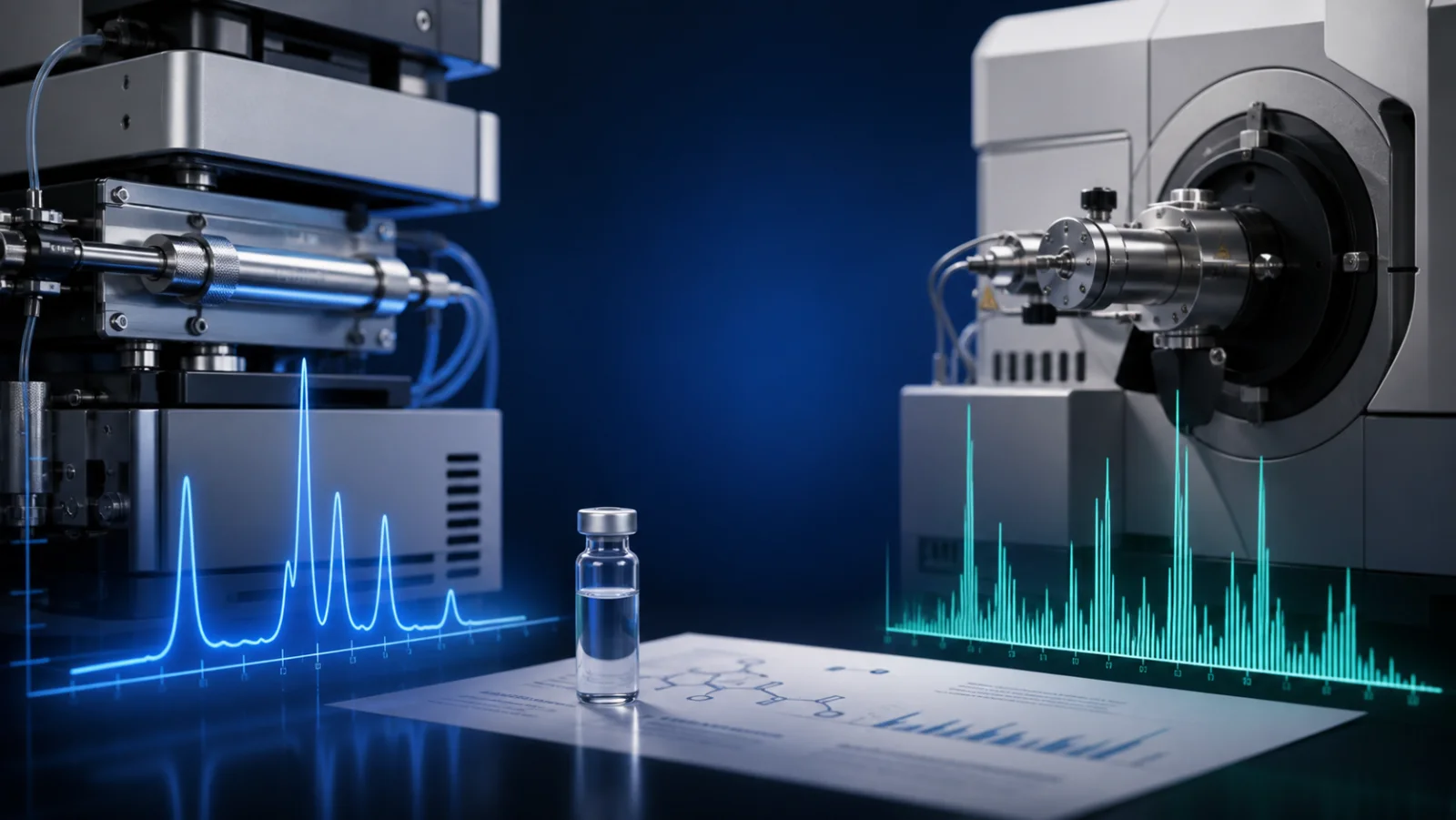
The chromatogram plots detector response against retention time. A major peak may correspond to the target material under the validated method, while smaller peaks may represent related substances or other detectable components. A reported area percentage is generally calculated from the integrated detector response included in that run; it should be interpreted within the scope and limitations of the stated method.
What an HPLC purity percentage does not automatically prove
- It does not independently confirm the molecular identity of every peak.
- It does not necessarily establish the total mass of peptide in the vial.
- It does not establish sterility, endotoxin status, elemental impurities, residual solvents, or microbiological quality unless separate suitable tests are reported.
- It does not show that the tested sample matches a particular vial unless the product, strength, batch or lot, and document identifiers also match.
The FDA’s Q2(R2) analytical-procedure guidance distinguishes identification from assay, purity, and impurity testing, and notes that additional procedures may be necessary when one procedure is not sufficiently selective. That is a useful general principle for reading analytical records: one method should not be asked to answer a question outside its validated purpose.
What does mass spectrometry show?
Mass spectrometry ionizes molecules and measures the resulting ions by their mass-to-charge ratio. For peptide characterization, observed ion signals can be compared with the expected molecular mass and charge-state pattern. Depending on the technique and method, a spectrum can support identity assessment, characterization, or investigation of related molecular species.
A matching mass signal is not the same as an HPLC purity percentage. Mass spectrometry is valuable because it supplies molecular information that a retention time or ultraviolet peak area alone may not provide. At the same time, a matching mass signal does not independently quantify all impurities or establish the labeled amount in a finished vial.
HPLC versus mass spectrometry at a glance
| Review question | HPLC record | Mass-spectrometry record |
|---|---|---|
| Primary analytical role | Separates detectable components under defined chromatographic conditions. | Measures ion mass-to-charge signals and supports molecular characterization. |
| Typical visible output | Chromatogram with retention times, peak responses, and integration. | Spectrum with mass-to-charge values, signal intensity, and possible charge states. |
| Common COA interpretation | Can support a stated chromatographic purity or impurity profile. | Can support whether observed molecular signals agree with expected identity. |
| Important limitation | Peak-area percentage is method-dependent and is not a complete quality profile. | A matching mass signal does not establish total purity, vial content, sterility, or batch identity by itself. |
| Best document-review use | Review the method, chromatogram, integration, result, and sample identifiers together. | Review expected and observed values, ion assignments, method details, and sample identifiers together. |
Why laboratories often use both methods
Separation and molecular characterization provide different evidence. Published peptide-characterization literature describes chromatography and mass spectrometry as complementary tools, and studies of peptide quality control show that higher-resolution LC–MS approaches can reveal certain related molecular species that may not be adequately distinguished by an HPLC-UV method alone.
This does not mean that every COA must use the same instrument, column, detector, or acceptance criteria. The appropriate analytical strategy depends on the material, intended analytical question, method capability, and the laboratory’s procedures. For procurement review, the important point is to identify what each reported result actually supports.
A practical COA review checklist
- Match the record: confirm the exact compound, strength, batch or lot, document date, and laboratory.
- Identify the method: look for the chromatographic or mass-spectrometric technique and enough method context to understand the result.
- Separate identity from purity: do not substitute a purity percentage for molecular-identity evidence, or a mass match for a complete impurity profile.
- Inspect the underlying output: review the chromatogram or spectrum when it is included, not only the summary line.
- Check the scope: determine whether sterility, endotoxin, residual solvent, water, elemental-impurity, or content testing is actually reported rather than assumed.
- Resolve mismatches: if the product and document identifiers do not align, request clarification before relying on the record.
How this applies to Pacific Research Peptides documentation
Use the Pacific Research Peptides COA library to locate published redacted records, then match the document to the exact catalog entry and available batch information. The COA verification guide provides a broader identifier and method checklist. For help locating an available document, use documentation support and include the product name, strength, batch or lot, and filename when available.
Primary and authoritative references
U.S. Food and Drug AdministrationQ2(R2) Validation of Analytical Procedures, final guidance, March 2024.
Mant et al.HPLC Analysis and Purification of Peptides.
JonssonMass spectrometry for protein and peptide characterisation.
FDA laboratory researchersLiquid Chromatography–High Resolution Mass Spectrometry for Peptide Drug Quality Control.
Prepared by: Pacific Research Peptides Research Team
Published and reviewed: August 24, 2026